Managing Rent at Scale: Why Property Managers Are Moving Beyond Manual Workflows

Table of Contents
- Why Managing Rent Isn't Just About Collecting It
- The Tax and Owner Payout Challenge
- What Happens to the Money Before the Owner Gets It?
- How Realtimate Changes the Workflow
- Reducing Administrative Work for Property Managers
- More Than Just Rent Collection
- Final Thoughts
- Frequently Asked Questions
Managing a rental property is about much more than collecting rent.
For a property management company, there’s a full workflow behind the scenes: onboarding tenants, managing agreements, tracking payments, handling deductions, and ensuring the right amount reaches the property owner.
This may be manageable with a few properties using spreadsheets and reminders. But as the portfolio grows, the same process quickly becomes complex, involving hundreds of transactions and multiple owners.
The challenge isn’t just rent collection.
It’s everything around it: before, during, and after the payment.
This is where a digital property management platform like Realtimate can help.
Why Managing Rent Isn't Just About Collecting It
For a property manager, collecting rent is only the first step.
A single payment may involve identifying the tenant and property, confirming whether the full rent was received, tracking pending or late payments, accounting for TDS and other deductions, recording management fees or expenses, calculating the final owner payout, and maintaining the transaction record for future reference.
Traditionally, these tasks are often handled across multiple tools and manual workflows:
- The tenant transfers the rent
- The payment is checked against the bank statement
- It is matched to the relevant property and tenant
- Details are entered or updated in a spreadsheet
- Missing or late payments are followed up
- Deductions and expenses are calculated
- The owner's payout is prepared and processed
- Records are updated for future reference
The process works, but the administrative effort adds up quickly.
A property manager may find themselves switching between bank statements, Excel sheets, CRMs, emails and messaging apps just to answer a simple question:
"Has this month's rent been collected, and how much does the owner need to receive?"
As the portfolio grows, this fragmented process becomes increasingly difficult to manage. A payment can be recorded against the wrong property, a deduction can be missed, or an owner payout can be calculated incorrectly. Even finding the details of a single transaction can require cross-checking information across multiple systems.
The challenge isn't that any one step is particularly complicated. It's that too many connected tasks are being handled separately.
This can make the process harder to manage consistently when transaction volumes increase.
The Tax and Owner Payout Challenge
Then comes another part of rental management that property managers cannot simply ignore: tax, deductions, and owner payouts.
Rent collection isn’t simply about moving money from one account to another.
Depending on the transaction and the parties involved, there can be TDS and other tax or accounting implications. For a company managing multiple properties and owners, keeping track of these details manually can quickly become a significant administrative task.
The team may need to track:
- Rent collected
- Applicable deductions
- TDS, where applicable
- Approved property-related expenses
- Final amount payable to each owner
A digital system doesn’t remove the underlying tax obligations. What it does is make the tracking and record-keeping around these transactions more organised and easier to manage.
Realtimate includes TDS within its Property Management workflow, connecting it with rent collection and disbursement instead of requiring property managers to manage each part separately.
The amount collected also isn't necessarily the amount the owner receives.
For example, a tenant may pay ₹50,000 in monthly rent, but the amount ultimately disbursed to the owner can differ depending on applicable deductions, TDS, expenses and the management arrangement.
The property manager therefore needs to determine the net payable amount before disbursement. When payouts are handled manually, even small errors can lead to:
- Incorrect payments
- Accounting mismatches
- Owner disputes
- Additional reconciliation and follow-ups
What Happens to the Money Before the Owner Gets It?
There is another question that becomes increasingly important as a property management company grows:
Where is the owner's money being held?
If rent collected on behalf of property owners moves through a company's regular operating account, the company has to carefully distinguish its own money from money belonging to its clients.
This can make reconciliation and fund tracking more complicated.
Realtimate's escrow-based workflow provides a structured way to handle funds collected as part of property transactions and track their movement toward the relevant stakeholders.
Instead of treating rent collection and owner payout as two completely separate activities, the money can be managed as part of a connected transaction flow.
This gives the property management company a clearer picture of:
- What was collected
- Where the money is
- What needs to be deducted
- What should be disbursed
- Who receives it
That visibility becomes increasingly valuable as the number of properties grows.
How Realtimate Changes the Workflow
This is where the difference between the traditional approach and a digital workflow becomes clear.
For a property manager handling rent collection on behalf of owners, the traditional process typically involves several separate steps:
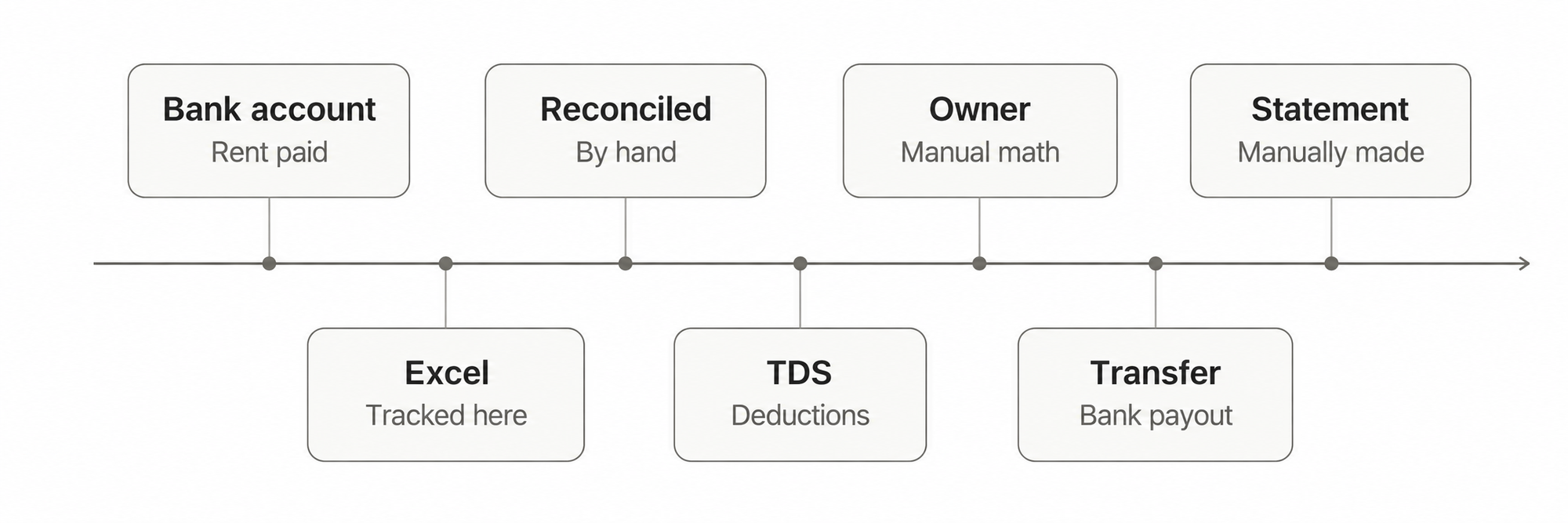
With Realtimate, the aim is to bring these activities into one connected workflow:
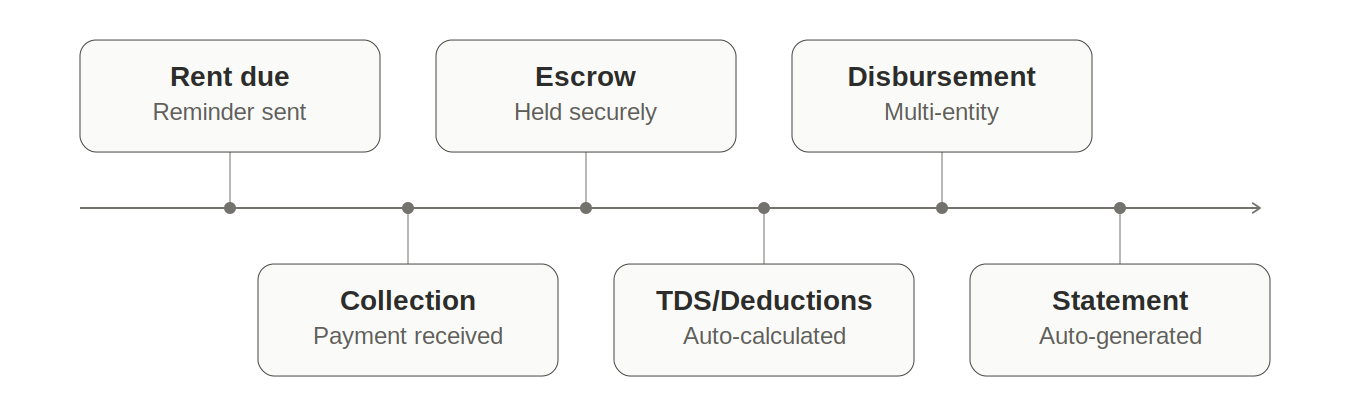
Instead of coordinating these activities across multiple disconnected tools, property managers can manage them through a connected property management workflow.
The difference isn't simply that the process is digital. It's that the individual steps are connected to one another, as the comparison below shows.
Traditional Property Management vs Realtimate:
The difference becomes particularly noticeable as the number of properties and transactions increases.
A manual system doesn't necessarily become more efficient when you add properties. It usually means adding more rows, more transactions and more work.
A connected digital workflow, on the other hand, is designed to handle those repetitive steps systematically.
Reducing Administrative Work for Property Managers
The biggest advantage of digitising rent management isn't simply that a tenant can pay online.
It's what happens around that payment.
Instead of employees spending their time:
- Checking bank statements
- Matching payments
- Updating spreadsheets
- Chasing late rent
- Calculating owner payouts
- Preparing statements
- Answering questions about individual transactions
the system can handle much of the repetitive administrative workflow.
That gives property managers more time to focus on what actually requires their attention:
- Managing properties
- Working with owners and tenants
- Resolving issues
- Growing the portfolio
This becomes especially important as a company scales.
If managing more properties simply means hiring more people to perform the same manual tasks, operational costs can grow alongside the portfolio.
The goal of digitisation is to make repetitive processes more efficient and easier to manage.
More Than Just Rent Collection
Rent management is also only one part of the property lifecycle.
Before rent can be collected, there is an agreement.
The parties involved may need to be verified.
The agreement may need to be e-stamped and electronically signed.
Then comes the ongoing rental relationship, including collections, fund management and owner payouts.
Realtimate brings several of these workflows together, including:
- Agreements
- E-stamping
- E-signing
- Stakeholder verification
- Background verification
- Escrow
- Property management
- Rent collection
This means the property manager can move from managing isolated tasks to managing a more connected property transaction lifecycle.
The goal is to bring more of that journey into one ecosystem.
Final Thoughts
Traditional property management methods aren't necessarily broken.
For a small portfolio, spreadsheets, bank transfers, and manual follow-ups may work perfectly well.
The challenge appears when the business grows.
More properties mean more tenants.
More tenants mean more payments.
More payments mean more reconciliation.
And more reconciliation means more time spent on administration.
At some point, the question isn't:
"Can we manage this manually?"
It's:
"Should we still be managing it manually?"
Realtimate is built to address that problem by bringing the rental money flow into a connected digital workflow from rent collection and escrow to TDS, disbursement, reminders, and statements.
The real benefit is not just replacing a spreadsheet. It is about reducing the number of disconnected steps a property management team has to manage every month.
Property managers should not have to spend their time figuring out where the money went. They should be spending it managing properties, serving their clients, and growing their business.
That is where a connected property management workflow can make the biggest difference.
Frequently Asked Questions
Why do property management companies struggle with manual rent collection?
Manual processes often require teams to reconcile bank transactions, update spreadsheets, follow up with tenants, calculate deductions and arrange owner payouts separately. As the number of properties increases, this creates more administrative work.
How does Realtimate simplify rent collection?
Realtimate brings rent collection into a broader property management workflow that includes automated reminders, escrow, TDS, disbursement and statements.
Why is escrow useful for property managers?
An escrow-based workflow provides a structured way to handle funds collected on behalf of property owners and track their movement toward disbursement. It also helps keep owner funds separate from the property manager’s operating funds, making transactions easier to track, reconcile, and document.
Does Realtimate support TDS?
Yes. TDS is included as part of Realtimate's Property Management workflow.
How does Realtimate help with owner payouts?
Realtimate supports multi-entity disbursement, helping property managers manage the distribution of collected funds to the relevant stakeholders.
Is Realtimate only for rent collection?
No. Realtimate also brings together workflows around agreements, e-stamping, e-signing, verification, escrow and property management.